
How to become a cricket umpire in Victoria (2026/27 guide)
· LexiCricket
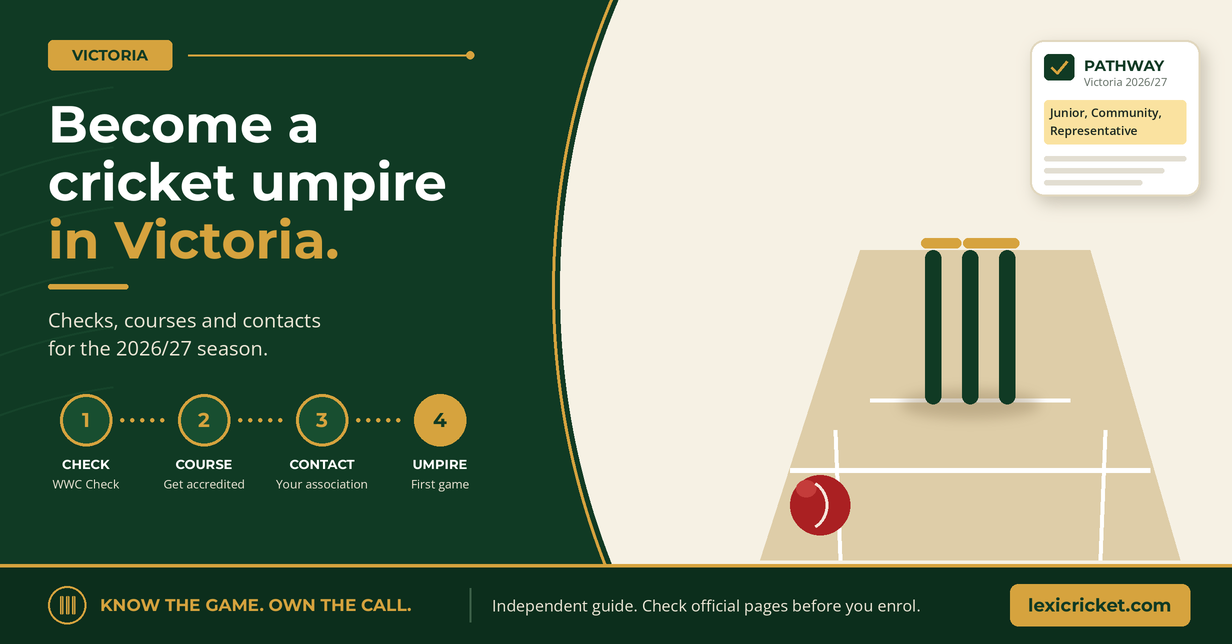
Every community cricket match in Victoria needs someone to make the calls, and the start of the 2026/27 season is a good time to become that person. You might be a player stepping back, a parent who has already stood in at junior games, or someone who wants a closer view of the game. The first steps are similar for all of them.
This guide walks through those steps in order: the check you need, the accreditation courses, who to contact, what to learn before your first game, and where the pathway can lead.
LexiCricket is an independent reference tool and is not affiliated with Cricket Victoria, Cricket Australia or any competition. Course details, costs and requirements change, so confirm them on the official pages listed at the end of this post before you enrol. Details were last checked on 19 September 2026.
Who can umpire cricket in Victoria?
Cricket Victoria describes umpiring as open to anybody. You do not need a high-level playing record, or any playing record at all. What you need is a sound knowledge of the Laws and the ability to apply them calmly and communicate clearly with players, captains and scorers.
Age requirements depend on where you live and umpire. Cricket Australia encourages umpires under 15 to complete its Umpiring Junior Cricket digital learning before moving on to formal accreditation, and advises checking local age requirements with your state or local umpiring contacts.
Cricket Victoria also runs two programs worth knowing about: a Junior Umpire Program for young people, usually aged 15 to 18, and an Umpiring for Women and Girls program. New dates for both are yet to be announced, so register your interest if either suits you.
Step 1: Get a Working with Children Check
Cricket Australia's umpire pages say you need a current Working with Children Check before you start, so plan on getting one whatever level you umpire. In Victoria, you apply for and manage your check through Service Victoria.
There are two types, Volunteer and Employee, and the choice has nothing to do with whether an association employs you. Under Victoria's Worker Screening Act 2020, the test is whether the work is for profit or gain, in other words whether you are paid for it. The Act covers work done under a contract for services as well as employment, so an umpire paid a match fee as a contractor is still doing paid work.
Which one fits:
- You umpire without being paid, for example as a club volunteer at junior games: a Volunteer check. Having your out-of-pocket expenses reimbursed does not change that.
- You are paid a match fee by an association or club: an Employee check. Using a Volunteer check for paid child-related work is an offence under the Act.
- You are a parent umpiring, unpaid, in the same activity your child plays in: the law exempts you, but your club or association can still require a check, and Cricket Australia asks umpires to hold one.
An Employee check covers volunteer work too, so if you expect to umpire both paid and unpaid games, get the Employee check. If you already hold a Volunteer check, you can change its type online instead of starting a new application. If your situation does not fit neatly, ask Working with Children Check Victoria before you start.
Step 2: Choose the right course
All umpiring courses sit on Cricket Australia's PlayCricket Learn platform, and you need a CricketPlus account to use it. To start a course, go to PlayCricket Learn for umpires and select Start Course on the one that fits.
Cricket Australia's platform and Cricket Victoria's umpiring page use different names for the same levels, so both are shown below in case you come across either.
Umpiring Junior Cricket
A short course for parents and other volunteers who will umpire junior matches. It is the natural first step if you are helping out at a junior club or you are under 15.
Community Umpiring certification
Cricket Australia describes this as the first stop for anyone new to umpiring. Cricket Victoria's page describes the entry course as Community Officiating accreditation, which replaced the old Level One course and is aimed at people who want to umpire club and senior cricket on a regular paid basis. It has two steps:
- Online course. Complete it on PlayCricket Learn at no cost.
- Workshop. Book a workshop through PlayCricket Learn, which shows sessions based on your role and location. Booking costs $40 at the time of writing.
Representative Umpiring certification
Cricket Australia lists this as the next step once you have completed Community Umpiring certification. Cricket Victoria calls it Representative Officiating accreditation, which replaced the old Level Two course, and says it is offered to umpires already umpiring in an official competition affiliated with a state association. Cricket Victoria describes online learning, two workshops of two hours each and an on-field assessment, lists an all-up cost of $100, and notes the course is being redesigned to align with the current Laws. Once you pass, your name is registered on the Cricket Australia and Australian Sports Commission databases of accredited umpires.
Whichever level you hold, reaccreditation is due every four years and is done through an online course.
Step 3: Contact your local association
Cricket Victoria's umpiring page directs new umpires to their local community cricket association. It includes a tool to find your nearest one, and a separate register-your-interest form that the Cricket Victoria umpiring team follows up. For general questions, the team can be reached at matchofficials@cricketvictoria.com.au.
When you make contact, ask the practical questions early:
- How are umpires appointed, and how do you give your availability?
- What uniform and equipment does the association expect?
- How does payment work, and when?
- Which playing conditions apply to each grade you might umpire?
- Can you stand with an experienced umpire in your first few games?
Cricket Australia's umpire pages also link to OfficialsHQ for umpire registration and login. Ask your association whether it uses it.
Step 4: Learn the Laws and your competition's playing conditions
Two sets of rules govern most community matches: the MCC Laws of Cricket and your competition's own playing conditions, which can change the Laws for things like the number of overs, fielding restrictions and hours of play. Where a competition's playing conditions change a Law, the playing conditions apply in that competition. If that relationship is new to you, read which cricket laws should govern my match.
Timing matters this season. A new edition of the MCC Laws takes effect on 1 October 2026, so study from the current edition rather than old notes, and check whether your competition's playing conditions say which edition applies. The main changes for umpires are covered in the 2026 Laws of Cricket changes. Cricket Australia also recommends the MCC Laws of Cricket app as a study resource.
Cricket Victoria runs an Umpire Development Program each off-season, with lectures and practical sessions for umpires at all levels. The 2026 program ran in June and covered the Law changes taking effect on 1 October 2026. Watch the Cricket Victoria umpiring page for next year's dates.
Match day: what to bring
Your association sets the uniform, so check that first. Beyond that, it helps to carry:
- A counter for balls in the over, plus a spare
- A pen and a notebook or card for recording times, overs, penalty runs and anything unusual
- A watch or phone to track the hours of play and intervals
- Spare bails
- The playing conditions for your competition and grade, printed or on your phone
- Sun protection and water, because a full day in the middle is long
Your first season: habits that help
- Arrive early. It gives you time to inspect the ground, find the scorers and settle before the toss.
- Meet both captains before play and confirm the match details: start time, overs, intervals and any competition-specific rules. Settling these before play prevents arguments during it.
- If you are standing with a colleague, agree who watches what and how you will signal to each other.
- Check in with the scorers at each interval so the book and your count agree.
- After each game, write down any situation you were unsure about and look up the answer while it is fresh.
- Cricket Australia suggests working with an umpiring mentor to build your knowledge and skills. Ask your association whether it can pair you with one.
Where the pathway can lead
For umpires who want to go further, the next step in Victoria is Premier Cricket. Cricket Australia notes that each state sets its own requirements for its Premier umpire panel. In Victoria, performance in Cricket Victoria's Umpire Development Program can lead to selection on the Premier Cricket Umpires Panel, and the exam after the 2026 program was compulsory for anyone seeking selection for 2026/27. Beyond Premier Cricket sits Cricket Victoria's State Umpiring Panel, which was announced for 2026/27 in September 2026.
Where LexiCricket fits
Questions in the middle are often about more than the Laws. They are about how your competition's playing conditions change them for your grade. LexiCricket answers rules questions from the playing conditions of the competition you select and shows the clause behind each answer, so you can check it against the source. If your competition is covered, ask a question in the chat. It is a reference that supports your training and judgement, not a replacement for either.
Frequently asked questions
Do I need to have played cricket to become an umpire?
No. Cricket Victoria describes umpiring as open to anybody. What you need is a sound knowledge of the Laws and the ability to communicate clearly.
How much does umpire accreditation cost in Victoria?
At the time of writing, the online part of Community Umpiring certification is free and the workshop costs $40 to book. Cricket Victoria lists an all-up cost of $100 for the representative course. Confirm current costs on PlayCricket Learn before you enrol.
Do cricket umpires get paid in Victoria?
Cricket Victoria describes the entry-level community course as designed for people who want to umpire on a regular paid basis. Ask your association how appointments and payment work in your competition.
Do I need a Working with Children Check to umpire?
Cricket Australia asks umpires to hold a current Working with Children Check before they start. The type depends on whether you are paid, not on whether the association employs you: unpaid umpires need a Volunteer check, and umpires paid a match fee need an Employee check, even as contractors.
How often do umpires need to reaccredit?
Every four years, through an online course for the level of accreditation you hold.
How old do you have to be to umpire?
It depends on where you live and umpire. Cricket Australia encourages under-15s to start with its Umpiring Junior Cricket module and advises checking local age requirements with your state or local umpiring contacts.
Sources
- Cricket Victoria: Umpiring
- Cricket Australia: PlayCricket Learn, Umpires
- Cricket Australia: PlayCricket Learn, About and FAQs
- Cricket Australia: Community Umpire
- Cricket Australia: Premier Cricket Umpire
- Working with Children Check Victoria: Volunteer to Employee Check
- Service Victoria: Working with Children Check
- Victorian Government: Worker Screening Act 2020
- Victorian Government: Exempt from Working with Children Check
Last checked: 19 September 2026.