
Non-striker run outs explained: Law 38.3 for umpires and scorers
· LexiCricket
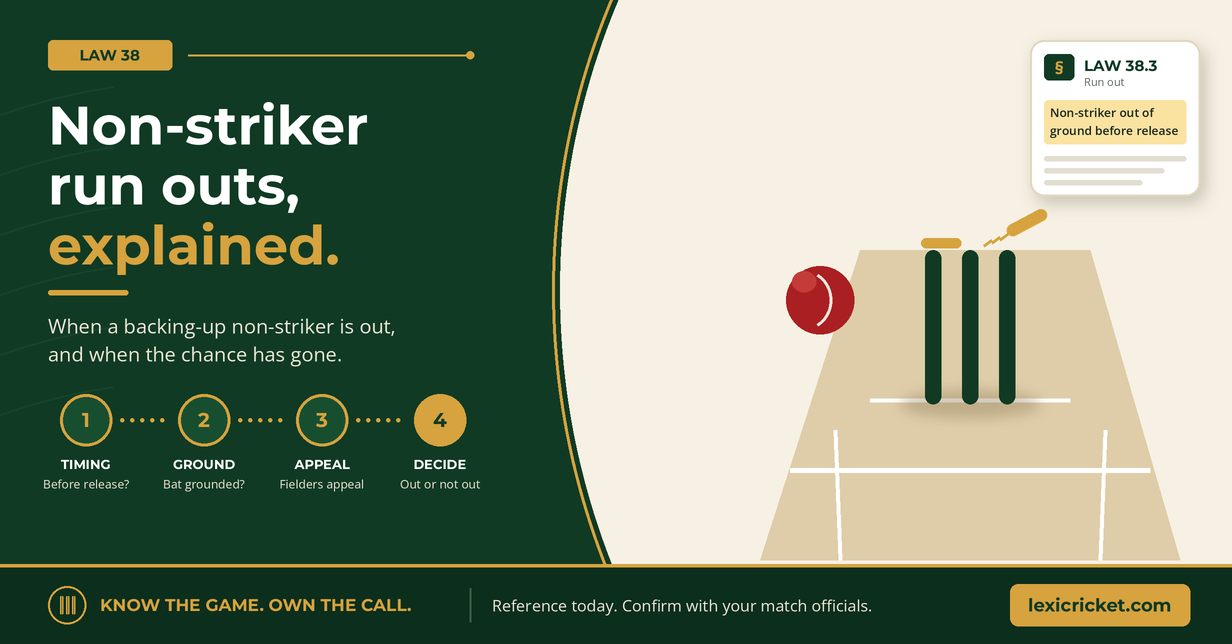
Few dismissals start more arguments at club level than a bowler running out the non-striker for backing up too early. It is often called a "Mankad", after the Indian all-rounder Vinoo Mankad, although many in the game now prefer the plain description. Whatever you call it, the Law is clearer than the arguments suggest.
This guide covers what the Law says, the timing test umpires apply, the myths that cause disputes, and how scorers record it.
LexiCricket is an educational reference, not an official match authority. Always check the published MCC Laws and your competition's playing conditions for the exact wording that applies to your match.
Where the Law sits: Law 38.3, not unfair play
The dismissal is covered by Law 38.3, Non-striker leaving his/her ground early, inside Law 38 (Run out).
That location matters. Until 2022 it sat in Law 41 (Unfair play). MCC moved it to the Run out Law in the 2022 update, keeping the wording the same, as part of an effort to remove the stigma around the dismissal. The message is simple: this is a run out like any other.
What the Law allows
From the moment the ball comes into play until the instant the bowler would normally have been expected to release it, the non-striker is liable to be run out if they are out of their ground.
In practical terms:
- The non-striker must stay in their ground until the ball is released. The responsibility sits with the batter, not the bowler.
- If the bowler breaks the wicket while the non-striker is out of their ground, within that window, and the fielding side appeals, the non-striker is out.
- If the non-striker has made their ground again before the wicket is broken, they are not out, even if they had left early.
The timing test: once the bowler reaches the release point, the chance is gone
This is the part umpires most need to get right, and it was clarified in January 2023.
MCC amended the wording of Law 38.3 after an attempted run out in a Big Bash League match at the MCG was ruled not out. The bowler had gone past the point in his action where he would normally have released the ball before breaking the wicket. MCC confirmed the umpire's decision was correct, and changed the wording to remove any ambiguity.
The clarified Law says that once the bowler reaches the point where they would normally have been expected to release the ball, they can no longer run out the non-striker under this Law, even if the non-striker left early.
For umpires, the question to ask is: had the bowler reached the point of expected release when the wicket was broken? If yes, not out under Law 38.3. If no, and the non-striker was out of their ground, out.
Myths that cause disputes
"The bowler has to warn the batter first"
Not in the Laws. MCC has stated that the Laws have never required a warning to the non-striker. A warning is a matter of custom, not Law. Your competition's playing conditions could add a requirement, so check them, but the MCC Laws do not.
"It's against the Spirit of Cricket"
MCC's position is that running out a non-striker who is trying to gain an advantage by leaving early is not against the Spirit of Cricket. Players and spectators will keep debating it, but that debate is not a ground for an umpire to give the batter not out.
"The bowler can wait for the batter to step out"
Only within the timing window. Once the bowler has reached the point of expected release, the Law no longer applies, however long they hold the ball.
Match-day checklist for umpires
- Watch the non-striker as well as the bowler's front foot. Positioning at the bowler's end makes this possible, but it takes practice.
- Judge the timing first. Had the bowler reached the point of expected release when the wicket was broken?
- Then judge the ground. Was any part of the non-striker's bat or person grounded behind the popping crease when the wicket was broken?
- Wait for an appeal. As with any dismissal, the umpire gives the batter out only on appeal.
- Stay calm and explain briefly. If a captain asks, name the Law (38.3) and the test you applied. Record the incident in your match report if your competition requires it.
How scorers record it
Record it as run out. It is not credited to the bowler as a wicket, the same as any other run out.
If you are unsure how an attempt that did not result in a dismissal affects the over or the ball count, check the exact wording of Law 38.3 in the current edition before the season, as this detail is easy to get wrong from memory.
Does the 2026 edition change this Law?
The new edition of the Laws takes effect on 1 October 2026. Law 38.3 does not appear among the headline changes in public coverage of the 2026 edition, which has focused on other Laws. Read the 2026 text to confirm the wording in force for your matches. Our guide to the 2026 Laws of Cricket changes covers the changes umpires will notice most.
Check your competition's playing conditions
Your match is governed by your competition's playing conditions as well as the MCC Laws. Competitions can set their own conditions that sit on top of the Laws. If you are unsure which document takes priority, our match-day checklist for deciding which cricket laws govern your match walks through it.
With LexiCricket, you can set your association in the chat and ask about non-striker run outs in plain language. Each answer shows the Law or playing condition it rests on. Confirm high-stakes rulings against the original document and your appointed officials.
Frequently asked questions
Is a non-striker run out legal in cricket?
Yes. It is a legitimate run out under Law 38.3 of the MCC Laws of Cricket.
Does the bowler have to warn the non-striker first?
No. The MCC Laws do not require a warning. Check your competition's playing conditions in case they add one.
When can the bowler no longer run out the non-striker?
Once the bowler has reached the point in their action where they would normally have been expected to release the ball. After that, a run out under Law 38.3 is not possible.
Is it still called "Mankading"?
The nickname is widely used, but the Law simply calls it the non-striker leaving their ground early, and it is recorded as a run out.
Does the bowler get credit for the wicket?
No. It is recorded as a run out, which is not credited to the bowler.