Cricket umpire signals explained: what each one means
· LexiCricket
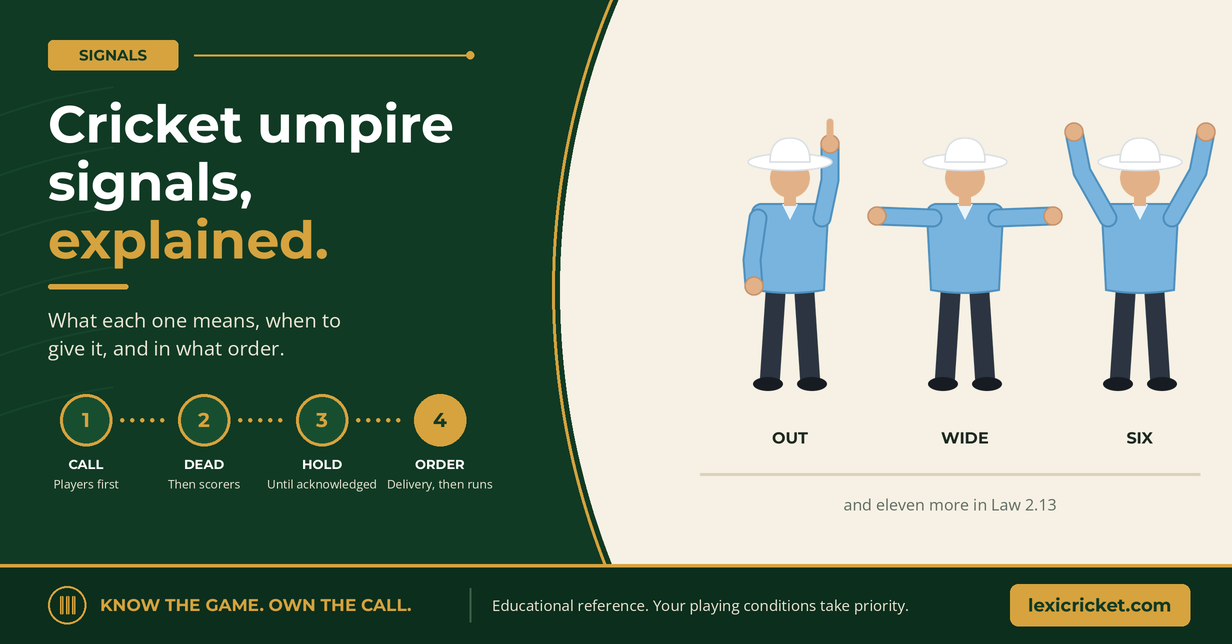
Signals are how an umpire talks to the scorers, and how everyone else finds out what just happened. Get them clean and the match runs smoothly. Get them vague and you end up walking to the scorers' table at the interval to fix a scorebook that no longer matches your card.
This guide covers the signals set out in the Laws, what each one means, when to give it, and what to do when more than one applies to the same delivery.
LexiCricket is an educational reference, not an official match authority. The signals themselves are described in Law 2.13, and your competition's playing conditions may add signals or change when some of them apply.
Two kinds of signal
It helps to separate them in your head.
Signals to the players, while the ball is live. No ball and Wide are called and signalled the moment you judge them, because the players need to know immediately. Dead ball is the same.
Signals to the scorers, once the ball is dead. Everything else waits. Four, six, byes, leg byes, short run, penalty runs, out: these go to the scorers after the ball is dead, and they must be acknowledged before you move on.
That is why No ball and Wide often end up being signalled twice. Once as a call to the players at the moment it happens, and again to the scorers when the ball is dead.
The signals
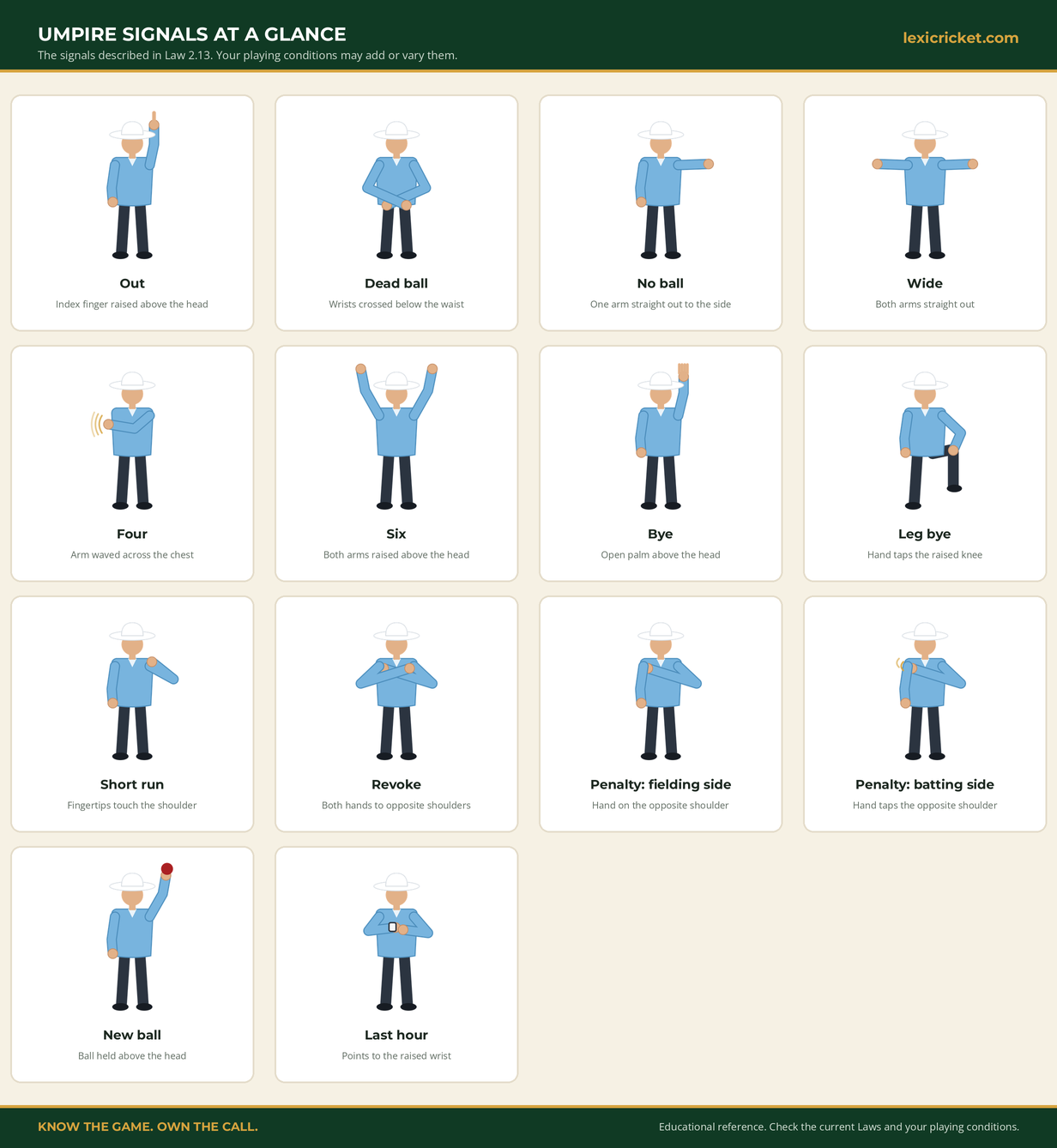
Out. Raise the index finger above the head. Only after an appeal, and only when you are giving the batter out.
Dead ball. Cross and uncross the wrists below the waist.
No ball. Extend one arm horizontally out to the side.
Wide. Extend both arms horizontally.
Four. Wave an arm from side to side, finishing with the arm across the chest.
Six. Raise both arms above the head.
Bye. Raise one open palm above the head.
Leg bye. Raise one leg and touch the knee with a hand.
Short run. Bend one arm up and touch the nearest shoulder with the fingertips.
Revoke the last signal. Touch both shoulders, each with the hand from the opposite side.
Penalty runs to the fielding side. Place a hand on the opposite shoulder.
Penalty runs to the batting side. Place a hand on the opposite shoulder and tap it, which is where the shorthand "pat on the shoulder means runs to the batting side" comes from.
New ball. Hold the ball above the head.
Last hour of the match. Point to a raised wrist with the other hand.
If you want the exact wording and the official illustrations, they are in Law 2.13 of the current edition, and the MCC Laws of Cricket app has them with animations.
The habits that make signals work
Wait for the ball to be dead. Signalling a boundary while a fielder is still chasing is how umpires end up revoking signals.
Face the scorers and stop moving. Find them first. On community grounds they might be in a shed, under a tree, or sitting in a car with the window down. If you cannot see them, do not signal into space.
Hold it until it is acknowledged. The Laws require the scorers to acknowledge your signals (Law 3), so hold the signal until they do, and repeat it if nothing comes back. A signal nobody saw did not happen.
Signal clearly and separately. When more than one signal applies, give them one at a time and let each be acknowledged before the next.
Use the right order. Give the signal that explains the delivery before the signal that explains the runs. A no ball that then goes for four is signalled No ball first, then Four. A wide that runs away for four extra is Wide, then Four.
Tell your colleague. Some decisions are shared. If you are at square leg and you have information the bowler's end umpire needs, agree before the match how you will pass it on.
The ones new umpires get wrong
Byes and leg byes on a no ball. Runs scored off a no ball are credited differently depending on whether the batter hit the ball. Signal the no ball, then the appropriate signal for the runs, and let the scorers do the rest.
Short run with multiple runs. Signal Short run and then make sure the scorers know how many runs you are allowing. Say it to them at the interval if there is any doubt.
Revoking. If you signal something and then realise you were wrong, revoke it and give the correct signal. It feels awkward, it takes five seconds, and it is far better than a wrong score.
Leg byes nobody asked about. If no run is attempted and the ball goes nowhere, there is nothing to signal.
What your playing conditions can change
The Laws are not the whole story. Competition playing conditions frequently change:
- What counts as a wide in limited-overs cricket, often with a marked line on the pitch
- Penalty runs, including penalties for slow over rates or for breaching a local code of conduct
- Free hits after a no ball, and how they are communicated
- Local signals for things like a drinks break or a one-day fielding restriction
Those conditions sit on top of the Laws. If you are not sure which document wins, read which cricket laws should govern my match.
Practising them
Signals are muscle memory. Three things help:
- Practise in front of a mirror or film yourself on a phone. Most umpires are surprised how small and hesitant their first signals look.
- Watch the umpires in any televised match for a session, with the sound off, and name each signal before the graphic appears.
- Agree a routine with your colleague before your first match. Where you look, who signals what, how you check with each other.
If you are getting ready to stand for the first time, the rest of the preparation is in your first match as a cricket umpire.
Where LexiCricket fits
Knowing the signal is the easy half. The harder half is knowing what your competition counts as a wide, when penalty runs apply in your grade, and whether your conditions change any of it. LexiCricket answers rules questions from the playing conditions of the competition you select and shows the clause behind each answer. If your competition is covered, ask a question in the chat.
Frequently asked questions
How many umpire signals are there in cricket?
The Laws set out the signals in Law 2.13, covering decisions such as out, dead ball, no ball, wide, four, six, bye, leg bye, short run, penalty runs, revoking a signal, a new ball and the last hour. Competitions can add their own.
What is the difference between a signal to the players and a signal to the scorers?
No ball, wide and dead ball are called and signalled immediately because play is affected. Everything else is signalled to the scorers once the ball is dead, and must be acknowledged.
Do scorers have to acknowledge umpire signals?
Yes. Under Law 3 the scorers acknowledge the umpire's signals, which is why you hold a signal until you get a response.
What does it mean when an umpire taps their shoulder?
A hand placed on the opposite shoulder signals penalty runs to the fielding side. The same action with a repeated tap signals penalty runs to the batting side.
In what order do you give two signals?
Signal the delivery first, then the runs. No ball then four, or wide then four, with each acknowledged before the next.
What if I signal the wrong thing?
Revoke it by touching both shoulders with the opposite hands, then give the correct signal and make sure the scorers acknowledge both.
Sources and further reading
- The published MCC Laws of Cricket, Law 2.13, and the MCC Laws of Cricket app for the official descriptions and illustrations
- Your competition's playing conditions, which can add signals or change when they apply
- Which cricket laws should govern my match
- Your first match as a cricket umpire
Last checked: 5 October 2026.