
Your first match as a cricket umpire? how to prepare
· LexiCricket
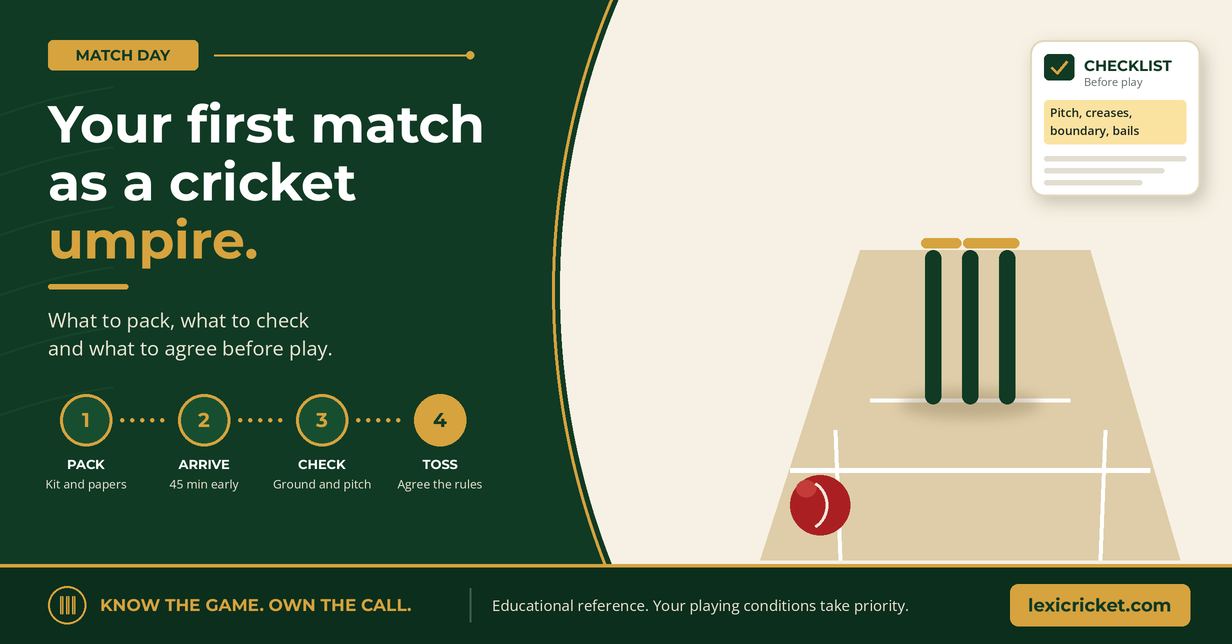
Most of the pressure in your first match comes from things you can sort out before the first ball. Where you stand, what you carry, what you have already agreed with the captains and your colleague. Get those right and you can spend the day watching cricket instead of improvising.
This is a preparation guide for community umpires: the week before, the bag, the ground checks, the toss, and what to do when play ends.
LexiCricket is an educational reference, not an official match authority. Your competition's playing conditions sit on top of the Laws and can change any of this, so read them and check anything you are unsure about with your association.
The week before
Confirm the appointment. Which ground, which grade, what time, and who your colleague is. Work out how to get there and how long it takes, including parking. Plenty of community grounds share an entrance with a football club or a reserve with three ovals and no signage.
Read the playing conditions for that grade. Not the association's conditions in general, the ones for the competition and grade you are standing in. Look for hours of play, number of overs, intervals, over limits for bowlers, fielding restrictions, and anything about over rates or time penalties. If working out which document governs what is new to you, read which cricket laws should govern my match.
Check which edition of the Laws applies. The MCC's 2026 edition came into force on 1 October 2026. Some competitions name an edition in their conditions and some do not. The changes most likely to come up are in the 2026 Laws of Cricket changes.
Check your paperwork is current. Accreditation and your state's working with children screening both expire. The requirements by state are in the guides for Victoria, NSW, Queensland, WA, South Australia and Tasmania.
What to pack
Your association sets the uniform, so confirm that first. For everything else, think in three groups.
On the field with you:
- A counter for the balls in the over, and a spare. Six coins work.
- A watch, set to the same time as your colleague's
- A pen and a small notebook or card for times, overs, penalty runs, bowler changes and anything unusual
- Something to mark the bowler's run-up
- Spare bails
- Sunglasses or prescription glasses, plus something to clean them
- Sunscreen, a hat and more water than you think you need
In your bag:
- The playing conditions for the competition and grade, printed or saved offline on your phone
- Any report or voting forms your association uses
- A basic first aid item or two, such as adhesive bandages
- A spare shirt. Long days in the sun are long days.
Possibly needed at the ground: some community grounds expect the umpires to help get the ground ready. Ask your association whether you are expected to carry a measuring tape, a mallet for the stumps or marking chalk, or whether the home club handles it.
When to arrive
Under the Laws, umpires are to report to the ground executive at least 45 minutes before the scheduled start (Law 2.1). Treat that as the minimum, not the target. Those 45 minutes are when the day is actually set up.
If this is your first match, arriving earlier buys you a calmer walk around the ground and time to meet your colleague properly before you are both busy.
Before the toss: the ground and the gear
Walk the ground with your colleague and sort out the things that cause arguments later.
The boundary. Know exactly where it is and what marks it: a line, a rope, a fence, a gutter, cones. Decide together how you will treat anything odd, such as a tree inside the playing area, a sightscreen that sits inside the boundary, or a section where the marker disappears. Agree it before the toss and tell the captains, so nobody is inventing a ruling while a ball is rolling towards it.
The pitch. Check the creases are marked and the stumps are pitched correctly and properly set in the ground.
The equipment. The Laws make the umpires responsible for satisfying themselves that the gear in use is acceptable, including the stumps and bails (Law 2.5). On a windy day, ask about heavy bails or whether bails will be used at all.
The toss and the captains' conversation
Two things happen before the toss, and both are yours.
Each captain nominates their players in writing to one of the umpires before the toss (Law 1.2). Take the team sheets and keep them.
Then the umpires meet the captains (Law 2.3). This is the single most useful five minutes of your day. Cover:
- Hours of play, intervals and the finish time
- Overs for the match and any limits on individual bowlers
- Any fielding restrictions and when they apply
- The boundary rulings you agreed on your walk around
- What happens if time or weather is lost
- Anything else specific to the competition, including over-rate or time penalties
The Laws set out when the toss takes place (Law 13.4), and competitions often restate or vary that in their own conditions, so confirm the time with the captains rather than assuming.
Agreeing with your colleague
New umpires often prepare the Laws thoroughly and forget this part. Before you go out, agree:
- How you will signal each other, and what you expect to be asked about
- What each of you watches at square leg, and whether you will cross for left and right hand batters
- Who keeps the official count of overs, and how you will check it with each other
- What you will do if one of you is unsighted for a run out or a catch
Then set both watches to the same time and be ready to walk out well before the scheduled start, letting the players know you are going on.
During the match
Keep the count your own way, every over, without relying on the scoreboard. Scoreboards in community cricket run behind and sometimes run wrong.
Check in with the scorers at every interval and compare overs, wickets and anything unusual such as penalty runs. Sorting a discrepancy at tea takes two minutes. Sorting it after stumps takes an argument.
When something happens that you were not sure about, note it down. That note is your study list for the week.
After play
Call time, take the bails off, and leave the field with your colleague. Before you go, confirm the scores with the scorers so the result that goes into the system is the one that happened on the field.
Then complete whatever your association requires. That usually means a match report and, in many competitions, player votes or ratings, submitted within a set window. Ask what the deadline is, because missing it is the most common thing a new umpire gets chased about.
Where LexiCricket fits
The questions that catch new umpires out are rarely about the Laws alone. They are about what your competition's playing conditions change for your grade. LexiCricket answers rules questions from the playing conditions of the competition you select and shows the clause behind each answer, so you can check it against the source. If your competition is covered, ask a question in the chat. It supports your preparation and judgement and does not replace either.
Frequently asked questions
How early should a cricket umpire arrive?
The Laws require umpires to report to the ground executive at least 45 minutes before the scheduled start (Law 2.1). For a first match, arriving earlier is worth it.
What should a cricket umpire carry?
A counter and a spare, a watch, a pen and notebook, something to mark the bowler's run-up, spare bails, sun protection and water, plus your competition's playing conditions and any forms your association uses.
Who checks the pitch and the boundary?
The umpires. Walk the ground before the toss, confirm the creases and stumps, and agree how you will treat anything unusual on the boundary before play starts.
What do umpires agree with the captains before the match?
The umpires meet the captains before the toss (Law 2.3). Cover hours, intervals, overs, bowling limits, fielding restrictions, your boundary rulings and anything specific to the competition.
Do captains have to give the team list in writing?
Yes. Each captain nominates their players in writing to one of the umpires before the toss (Law 1.2).
Do I need to know the 2026 Laws for my first match?
Learn the current edition, which came into force on 1 October 2026, and check whether your competition's playing conditions name an edition or change anything in it.
Sources and further reading
- The published MCC Laws of Cricket, including the MCC Laws of Cricket app, for the exact wording of any Law referenced here
- Your competition's playing conditions, which take priority where they change a Law
- Which cricket laws should govern my match
- 2026 Laws of Cricket changes
Last checked: 3 October 2026.