How to become a cricket umpire in NSW (2026/27 guide)
· LexiCricket
Cricket NSW says demand for qualified umpires is always high, from junior cricket to Sydney grade matches and country competitions. If you have been thinking about umpiring, the start of the 2026/27 season is a good time to begin.
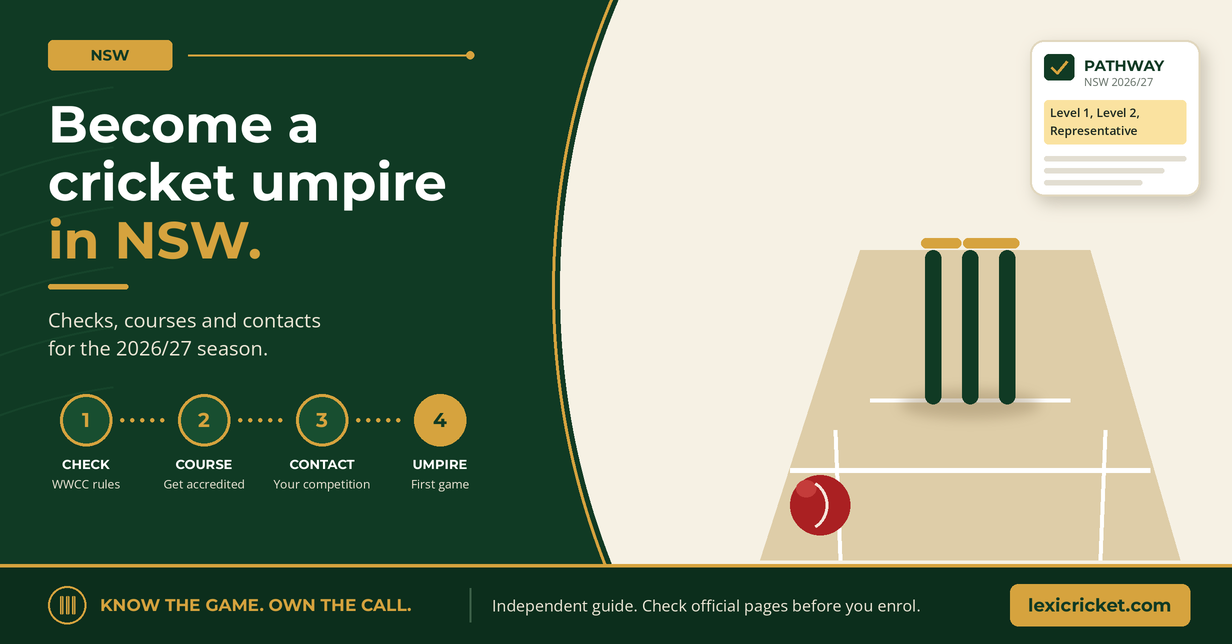
This guide walks through the steps in order: whether you need a Working with Children Check, which course fits, who to contact, what to learn before your first game, and where the pathway can lead.
LexiCricket is an independent reference tool and is not affiliated with Cricket NSW, Cricket Australia, NSWCUSA or any competition. Course details, costs and requirements change, so confirm them on the official pages listed at the end of this post before you enrol. Details were last checked on 20 September 2026.
Who can umpire cricket in NSW?
Cricket NSW describes umpiring as open to men and women of all ages and stages of life, from young people starting out to retirees who want to stay active on weekends. The NSW Cricket Umpires and Scorers Association (NSWCUSA) says its members include students, professionals, parents and retirees. You do not need a playing record. You need a sound knowledge of the Laws and the ability to manage a match calmly.
Age requirements depend on where you umpire. Cricket Australia encourages umpires under 15 to complete its Umpiring Junior Cricket digital learning before moving on to formal accreditation, and advises checking local age requirements with your state or local umpiring contacts.
Step 1: Work out whether you need a Working with Children Check
NSW handles this differently from some other states, so it is worth reading carefully.
Under NSW law, umpiring is not child-related work when it does not ordinarily involve contact with children for extended periods without other adults being present. The Office of the Children's Guardian lists umpires and referees in that situation among the roles that do not need a check. Parents and close relatives volunteering at their children's usual activities are also exempt, and NSWCUSA notes that a check is not needed for a parent umpiring a match their own child is playing in. People under 18 are exempt too.
The law is only part of the picture. Cricket Australia's umpire pages say you need a current Working with Children Check before you start, and your association can set its own requirement. Ask your association before your first game. If it wants you to hold a check, or you are unsure, getting one is the safe default.
If you do get one, choose the right type:
- You umpire without being paid: a volunteer check, which is free.
- You are paid a match fee: a paid check. The Office of the Children's Guardian lists the fee as $112, paid at Service NSW. NSW requires anyone in paid child-related work to hold a paid check, and a volunteer check holder who starts paid child-related work must upgrade within 30 days.
You apply online through the Office of the Children's Guardian, then verify your identity at a Service NSW centre. You must be in NSW to complete the application.
Step 2: Choose the right course
NSW has two main entry-level accreditations, and which one you need depends on the cricket you want to umpire.
CA Community Officiating (Level 1)
NSWCUSA describes this as ideal for junior cricket. It has two parts: an online component of around an hour, then a workshop of around three hours covering 19 key Laws. Workshops run throughout the year, both in person around NSW and online via Zoom. NSWCUSA lists the cost as $40, free for female participants. Cricket NSW also runs Community Officiating courses for associations during the year.
The online component sits on Cricket Australia's PlayCricket Learn platform, which needs a CricketPlus account. To start, go to PlayCricket Learn for umpires and select Start Course.
NSWCUSA Laws of Cricket Training Course (Level 2)
This course introduces all 42 Laws of Cricket. Passing the assessment gives you an accreditation suited to senior cricket, including NSW Premier Cricket, and an invitation to join NSWCUSA. It runs over five weeknights (on Zoom or in person), over a weekend, or in a single day. The cost varies by format, and the course is free for existing NSWCUSA members and prospective female umpires. Find dates on the NSWCUSA upcoming courses page.
CA Representative Officiating
NSWCUSA lists this as a requirement for the higher grades of NSW Premier Cricket and for NSW Country Cricket representative programs. It is a step for umpires already officiating, not a starting point.
Cricket Australia umpire accreditation is valid for four years.
Which one fits you:
- Junior cricket: Community Officiating.
- Sydney Premier Cricket or Sydney Shires: the NSWCUSA Level 2 course, then NSWCUSA membership (see Step 3).
- Any other competition: ask the association which qualification it expects.
Step 3: Find where you will umpire
Where you start decides who you contact.
- Sydney Cricket Association competitions (NSW Premier Cricket and Sydney Shires): Cricket NSW says you must become a member of NSWCUSA by attending an umpiring course and passing an entrance exam. NSWCUSA can be reached at umpires@cricketnsw.com.au.
- Other competitions in Sydney and across NSW: Cricket NSW recommends contacting the local association directly to find out which qualifications apply. Many senior competitions also have their own umpires association.
- Regional NSW: the Cricket NSW umpiring page lists zone umpire representatives who can tell you about training in your area.
Cricket NSW notes that umpires are often eligible for a match payment, with rates set by the association that runs the competition. When you make contact, ask:
- How are umpires appointed, and how do you give your availability?
- What uniform and equipment are expected?
- How does payment work, and does the association require a Working with Children Check?
- Which playing conditions apply to each grade you might umpire?
- Can you stand alongside an experienced umpire in your first few matches?
Step 4: Learn the Laws and your competition's playing conditions
Most matches are governed by two sets of rules: the MCC Laws of Cricket, and the playing conditions of your competition, which can change the Laws for things like overs, fielding restrictions and hours of play. Where a competition's playing conditions change a Law, the playing conditions apply in that competition. If that is new to you, read which cricket laws should govern my match.
A new edition of the MCC Laws takes effect on 1 October 2026, so study the current edition and check whether your competition's playing conditions say which edition applies. The main changes are covered in the 2026 Laws of Cricket changes. NSWCUSA's website also has Laws of Cricket and playing conditions resources.
Match day: what to bring
Check your association's uniform requirements first. After that, a useful kit includes:
- A ball counter, with a spare
- A pen and notebook or card for times, overs, penalty runs and incidents
- A watch or phone for hours of play and intervals
- Spare bails
- Your competition's playing conditions, printed or saved on your phone
- Sun protection and plenty of water
Your first season: habits that help
- Get to the ground early to inspect the pitch and surrounds, meet the scorers and settle in before the toss.
- Confirm the match details with both captains before play: start time, overs, intervals and any competition rules.
- If you have a colleague, agree on who watches what and how you will signal each other.
- Check your count against the scorers at every interval.
- Note anything you were unsure about during the day and look it up that evening.
- Ask your association whether an experienced umpire can mentor you through your first season.
Where the pathway can lead
NSWCUSA says most umpires start in local competitions across NSW or in the lower grades of NSW Premier Cricket, where the Level 2 accreditation is required. Representative Officiating opens the higher grades and country representative programs. Umpires who perform to a consistently high standard there can be selected for the Cricket NSW State Umpiring Panel or NSWCUSA's Country Umpire Representative Panel, and from there the national and international pathway.
Where LexiCricket fits
Most on-field questions depend on your competition's playing conditions, not just the Laws. LexiCricket answers rules questions from the playing conditions of the competition you select and shows the clause behind each answer, so you can check it against the source. If your competition is covered, ask a question in the chat. It supports your training and judgement and does not replace either.
Umpiring in Victoria instead? Read how to become a cricket umpire in Victoria.
Frequently asked questions
Do I need a Working with Children Check to umpire cricket in NSW?
Not always under NSW law. Umpiring is not child-related work when it does not ordinarily involve extended contact with children without other adults present, and parents umpiring their own child's match are exempt. However, Cricket Australia asks umpires to hold a current check and your association may require one, so confirm with your association. A volunteer check is free, and a paid check costs $112.
How much does it cost to become an umpire in NSW?
At the time of writing, NSWCUSA lists CA Community Officiating at $40, free for female participants. The Level 2 Laws of Cricket Training Course cost varies by format and is free for NSWCUSA members and prospective female umpires. Confirm current costs with NSWCUSA before you enrol.
Do cricket umpires get paid in NSW?
Often. Cricket NSW says umpires are often eligible for a match payment, with rates set by the association running the competition.
How do I umpire Sydney grade cricket?
Complete an NSWCUSA umpiring course, pass the entrance exam and join NSWCUSA. The Level 2 accreditation is required for the lower grades of NSW Premier Cricket, and Representative Officiating is required for the higher grades.
How long does umpire accreditation last?
Cricket Australia umpire accreditation is valid for four years.
How old do you have to be to umpire?
It depends on where you umpire. Cricket Australia encourages under-15s to start with its Umpiring Junior Cricket module and advises checking local age requirements with your state or local umpiring contacts.
Sources
- Cricket NSW: Umpiring
- Cricket NSW: Senior Community Cricket
- NSWCUSA: Umpiring
- NSWCUSA: Representative Umpires
- NSWCUSA: Upcoming Courses
- Cricket Australia: PlayCricket Learn, Umpires
- Cricket Australia: Community Umpire
- Cricket Australia: Umpire Development
- Office of the Children's Guardian: Who needs a Check
- Office of the Children's Guardian: WWCC FAQs
- Office of the Children's Guardian: Update or upgrade your WWCC
Last checked: 20 September 2026.