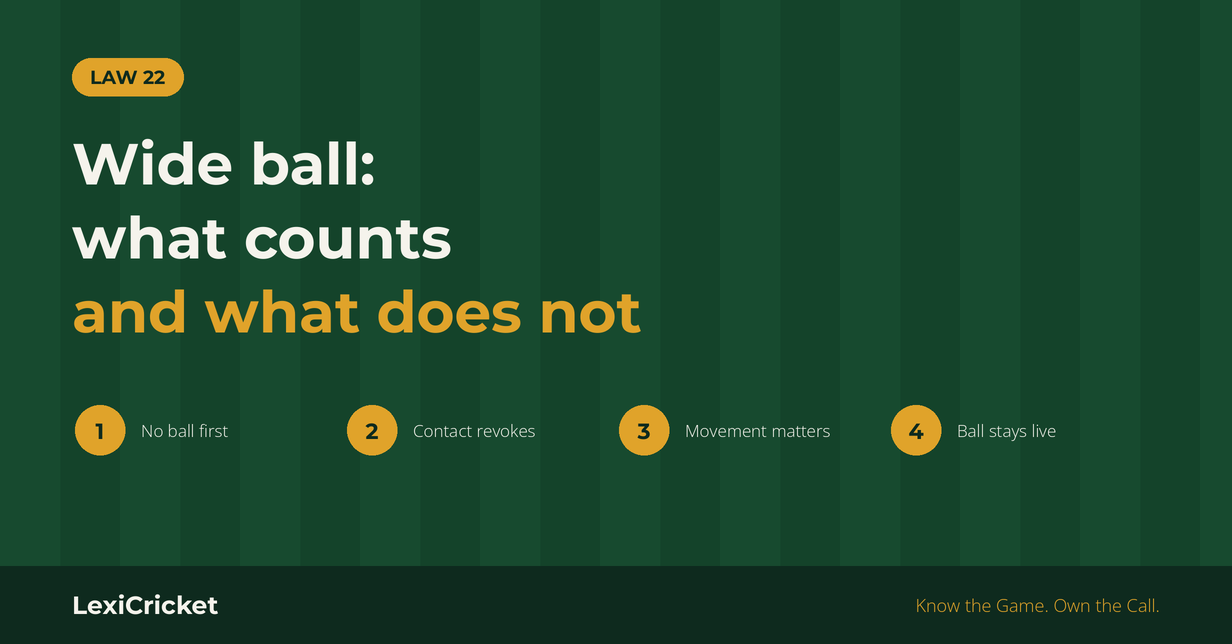
Wide ball in cricket: what counts and what does not
· LexiCricket
A wide looks like the simplest call in cricket. The ball goes past the striker, nobody plays at it, you put your arms out. Then a striker backs away to leg, the ball goes through where he used to be standing, and suddenly the simple call has a decision inside it.
Law 22 is short, but it packs in two tests, two ways the call gets revoked, and a list of dismissals that catches people out. This post covers what the Law actually says, the moments umpires get asked about most, and where your competition's playing conditions change things.
LexiCricket is an independent reference tool and is not affiliated with the MCC, Cricket Australia or any competition. The clause numbers below are from the MCC Laws of Cricket. Always check what your competition's playing conditions say, because many of them change the wide interpretation. Details were last checked on 7 October 2026.
The two tests for a wide
Law 22.1 sets two conditions, and both have to be satisfied.
First, the ball has to pass wide of where the striker is standing, or where the striker has stood at any point after the ball came into play for that delivery. That second half is the part people forget. The reference point is not only where the striker is at the moment the ball goes past. It includes anywhere he or she has stood since the ball came into play.
Second, the ball has to be one that would also have passed wide of the striker standing in a normal guard position. The Law puts it as a normal batting position.
Both tests. A ball that goes past a striker who has walked a long way across to the off side is not a wide if it would have been reachable from a normal stance.
The Law also gives you the standard for judging reach. The ball is considered to have passed wide of the striker unless it is sufficiently within reach for the striker to be able to hit it with a normal cricket stroke. Not a stretch, not a lunge, not a reverse sweep. A normal stroke.
High deliveries
Law 22.1.3 is a separate route to a wide and it has its own trigger. A delivery that, after landing, passes over head height of the striker standing upright at the popping crease is a wide.
Two words do the work there. "After landing" means a full toss over head height is not dealt with here, that is a no ball under Law 21. And "standing upright at the popping crease" fixes the reference point, so a striker who is crouched, ducking or well back in the crease does not change the measurement.
If you take one thing away, take this: bounced over head height is a wide, full toss over head height is a no ball. Law 21 is covered in no ball in cricket explained.
When to call it, and when to call it off
Law 22.2 tells you to call and signal wide ball as soon as the ball passes the striker's wicket. You do not wait to see whether the keeper gathers it. And if the call is made, the delivery is treated as a wide from the instant the bowler entered the delivery stride, which is what allows the penalty and any dismissal to work properly.
The call can then be revoked, in two situations only.
- Contact. Law 22.3.1. If there is contact between the ball and the striker's bat or person before the ball touches a fielder, the call is revoked. A thin glove on a leg-side delivery takes the wide away.
- No ball. Law 22.3.2. If the delivery is called a no ball, the wide call is revoked. A delivery cannot be both.
Revoking a call out loud matters. Say it, and make sure your colleague and the scorers have it, because the scorers are mid-entry by then.
When it was never a wide
Law 22.4 covers two situations where the call should not be made at all.
The striker's own movement is the first. If the striker, by moving, either causes the ball to pass wide of where he or she is standing, or brings the ball within reach, it is not a wide. That cuts both ways, and it is the clause that answers the question at the top of this post. A striker who backs away to leg as the ball is released does not earn a wide for the gap he just created, provided the delivery would have been reachable from a normal position.
The second is contact, again from the other direction. If the ball touches the striker's bat or person, it is not a wide.
The ball is not dead
Law 22.5 is one line and it is worth saying to every new umpire. The ball does not become dead on the call of wide ball.
Play continues. The batters can run. A wide can be a boundary. A wide can produce a run out or a stumping. Hands out, voice up, then back to watching the cricket, because something is still live and the signal is not the end of the ball.
The penalty and the scoring
Law 22.6 awards a penalty of one run instantly on the call. That penalty stands even if a batter is then dismissed off the delivery.
Law 22.7 then deals with everything else from that ball. All runs completed by the batters, or any boundary allowance, are scored as wides along with the penalty, and the whole lot is debited against the bowler. So a wide that runs away for four to the boundary is five wides, all against the bowler's analysis.
Law 22.8 keeps the ball out of the count. A wide does not count as one of the over.
That combination is what makes clear communication with the scorers so important. One signal from you decides a penalty run, how any runs off the ball are recorded, whose analysis they go against, and whether the over has moved on. Reconcile at each interval rather than at the end.
How a batter can be out off a wide
Law 22.9 lists the only ways the striker can be dismissed off a wide:
- Hit wicket, Law 35
- Obstructing the field, Law 37
- Run out, Law 38
- Stumped, Law 39
Compare that with a no ball, where the striker cannot be stumped and cannot be out hit wicket. The two lists are close to inverses of each other, and that is the single most useful thing to know about both Laws.
So yes, a batter can be stumped off a wide. The keeper takes a wide one down the leg side, the striker has overbalanced out of the crease, and the stumping stands. The wide penalty still counts as well.
One absence is worth noticing. Hit the ball twice, Law 34, is not on the list, and it cannot be, because any contact with the bat revokes the wide in the first place.
Where your playing conditions come in
Law 22 is the baseline, not the final word. Limited-overs competitions very commonly add their own wide interpretation, and often a stricter one for deliveries down the leg side, sometimes with a marked line on the pitch or a reference to the return crease. Junior formats can modify it further.
That is a competition-by-competition question, not a general one. The playing conditions for your grade are what you have to apply, and two grades in the same association can differ. If the relationship between the Laws and playing conditions is new to you, read which cricket laws should govern my match.
Ask at your pre-season meeting, or at the toss if you are standing in a grade you do not usually do:
- Does this competition have its own wide interpretation, and is it different for leg side and off side?
- Is a line marked, and where is it measured from?
- Does the interpretation change for junior or female grades?
- Is there anything about a wide for a delivery that passes behind the striker's legs?
A quick decision order
When a delivery goes through and nobody plays at it, run the questions in this order.
- Was it a no ball? If it was, there is no wide to consider.
- Did it touch bat or person? If it did, it is not a wide, or the call is revoked.
- Did the striker's movement create the gap, or bring the ball within reach? If so, no wide.
- Did it pass wide of where the striker is standing or has stood, and would it also have passed wide of a normal batting position? If yes to both, wide.
- Did it pass over head height after landing, measured at the popping crease and standing upright? If yes, wide.
- Signal, then keep watching. The ball is still live.
Where LexiCricket fits
Most wide questions in the middle are not really Law 22 questions. They are questions about what your competition has done to Law 22. LexiCricket answers rules questions from the playing conditions of the competition you select and shows the clause behind each answer, so you can check it against the source. If your competition is covered, ask a question in the chat. It supports your training and judgement and does not replace either.
Frequently asked questions
Is it a wide if the batter walks across and the ball goes behind him?
Not automatically. Law 22.1 requires both that the ball passed wide of where the striker is standing or has stood, and that it would also have passed wide of the striker in a normal batting position. Law 22.4.1 adds that it is not a wide if the striker, by moving, caused the ball to pass wide. If the delivery would have been reachable from a normal stance, there is no wide.
Can a batter be stumped off a wide?
Yes. Law 22.9 lists stumped as one of four dismissals available off a wide, along with hit wicket, obstructing the field and run out. The one-run wide penalty still stands.
Is a ball over head height a wide or a no ball?
If it passes over head height after landing, it is a wide under Law 22.1.3, measured against the striker standing upright at the popping crease. A full toss over head height is dealt with under Law 21.
Does a wide count as a ball of the over?
No. Law 22.8 says a wide does not count as one of the over.
How are runs off a wide recorded?
Law 22.7 scores the penalty plus all completed runs or any boundary allowance as wides, and debits them all against the bowler. A wide that goes to the boundary is five wides.
Can a delivery be both a wide and a no ball?
No. Law 22.3.2 revokes a wide call if the delivery is a no ball.
Does the ball become dead when I call wide?
No. Law 22.5 says the ball does not become dead on the call, so play continues and runs, boundaries, run outs and stumpings are all still live.
Sources
- MCC Laws of Cricket: Law 22, Wide ball
- MCC Laws of Cricket: Law 21, No ball
- MCC Laws of Cricket: Law 17, The over
Last checked: 7 October 2026.