No ball in cricket: the front foot, the back foot and the rest
· LexiCricket
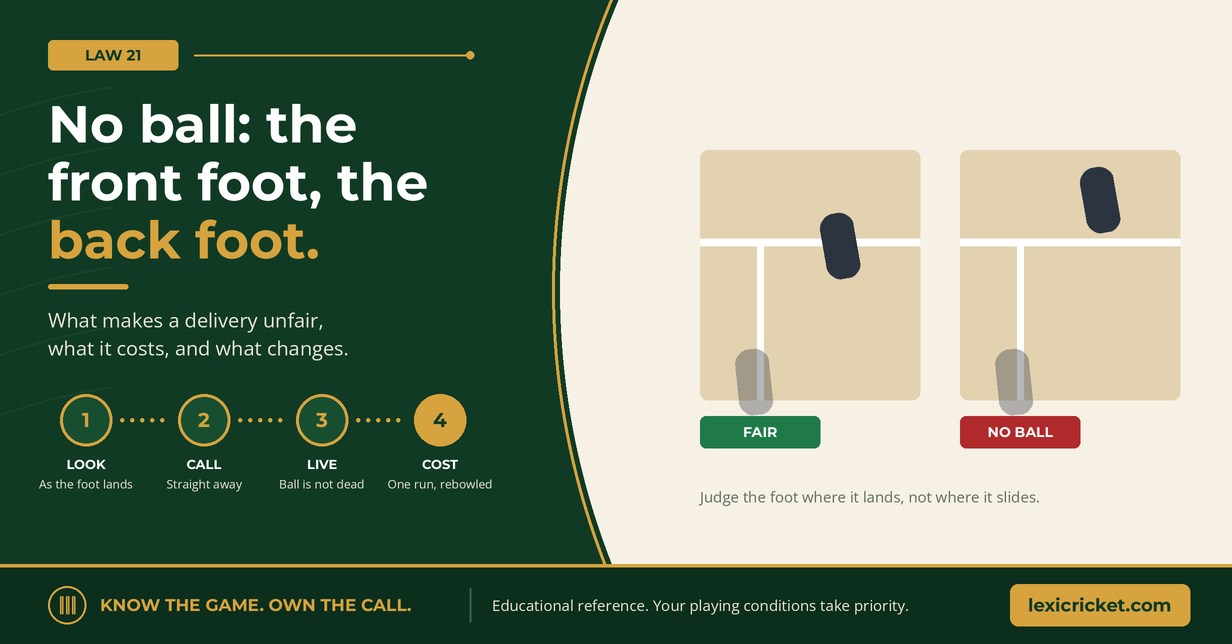
The no ball is the most argued call in community cricket. Bowlers think they were behind the line, batters think they were not, and the umpire has about a fifth of a second to decide while also watching where the ball goes.
This guide covers what actually makes a delivery a no ball, where to look as the bowler lands, what the call costs, and the parts your competition's playing conditions change.
LexiCricket is an educational reference, not an official match authority. Law numbers here follow the published MCC Laws of Cricket. Your competition's playing conditions can add to this, and often do.
What the Laws ask of the feet
Law 21.5 sets two separate tests, and a delivery has to pass both.
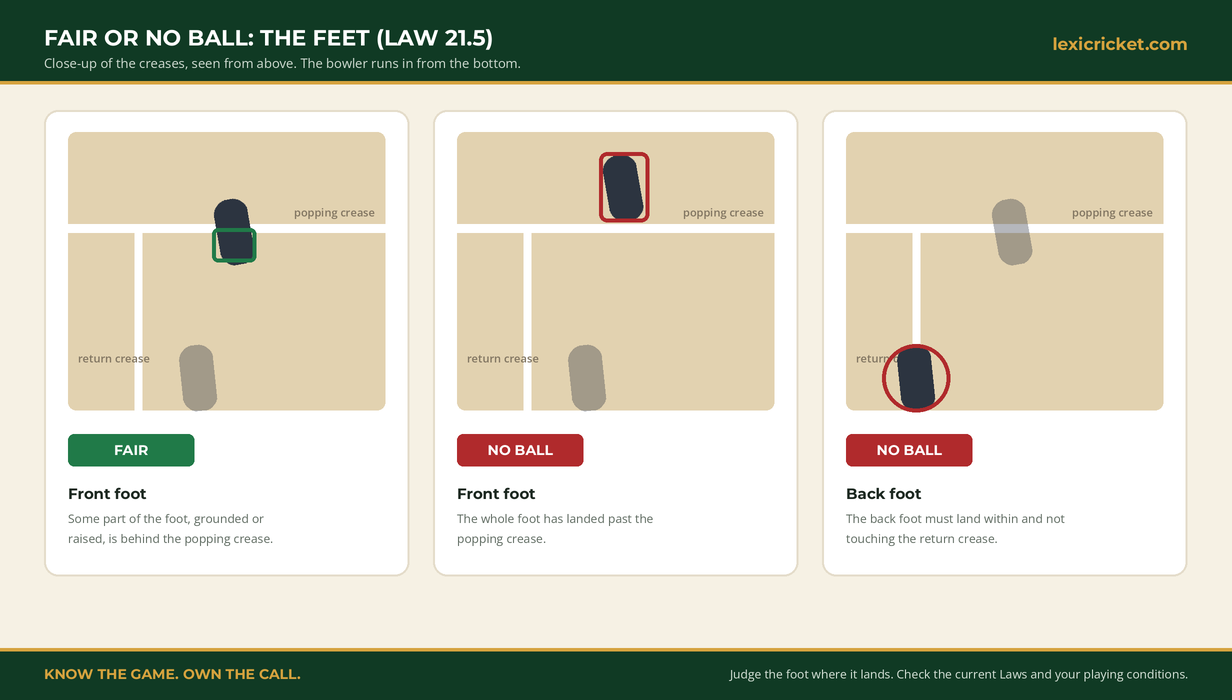
The back foot must land within and not touching the return crease on the side the bowler said they would bowl from. The return crease is the line running down the side of the pitch. It is a hard line: touching it is already a no ball.
The front foot must land with some part of the foot, whether grounded or raised, behind the popping crease, and on the same side of the imaginary line joining the two middle stumps as that return crease.
Three things follow from that wording, and they are where most arguments start.
"Some part of the foot" is generous to the bowler. If any part of the front foot is behind the popping crease, the delivery is fair, even if the rest of the foot is over the line.
"Whether grounded or raised" matters. A heel in the air still counts, as long as it is behind the line. You are judging the whole foot, not just the part touching the ground.
Landing is what counts. Judge the back foot where it lands, not where it slides to afterwards. A foot that lands inside the return crease and then drags across it is a fair delivery.
Worth noting too: the front foot can land wide of the return crease. The return crease test applies to the back foot.
Where to look, and when
The common mistake is staring at the popping crease. If your eyes are locked on the line, they will not refocus on the striker in time to judge anything else.
A routine that works:
- Watch the striker as the bowler runs in, so your eyes are already set at that distance.
- As the bowler reaches the delivery stride, drop your eyes to the landing area.
- Judge the feet, then come straight back up to follow the ball.
Stand where you can see the whole landing zone without moving your head. If you are craning or shuffling as the bowler arrives, you are too close.
And call it the moment you see it. The call has to reach the batter in time to be useful.
The other ways a delivery becomes a no ball
Feet are the common one, not the only one.
- Throwing. The delivery is not fair in respect of the arm (Law 21.2). Either umpire may call it.
- Mode of delivery changed without notice. The bowler must tell the umpire whether they bowl right or left arm, over or round the wicket. Changing without telling you is a no ball (Law 21.1).
- Multiple bounces, rolling, or landing off the pitch. A ball that bounces more than once or rolls along the ground before reaching the popping crease, or that pitches wholly or partly off the prepared pitch, is a no ball (Law 21.7).
- Ball coming to rest in front of the striker's wicket (Law 21.8).
- Dangerous and unfair bowling. High full tosses and excessive short-pitched bowling are dealt with under Law 41, and the delivery is a no ball.
- Fielding infringements. A wicketkeeper not wholly behind the wicket, or too many fielders behind square on the leg side, makes the delivery a no ball.
- A deliberate front-foot no ball, which the Laws treat seriously under Law 41.8.
What a no ball costs
- Penalty. One run to the batting side (Law 21.14), on top of any runs scored.
- The over. The delivery does not count as one of the six.
- The ball. It is not dead on the call (Law 21.13), so play continues.
- Dismissals. The striker cannot be bowled, caught, stumped, LBW or out hit wicket. Run out, obstructing the field and hit the ball twice still apply (Law 21.17).
That last one is the point to have ready. When a bowler knocks the stumps over off a no ball and the fielding side goes up, you need the answer immediately, not after a conference.
What your playing conditions change
This is where competitions differ most, so check yours rather than assuming:
- Free hits. Whether a no ball brings a free hit, which no balls trigger one, and how it is signalled
- Short-pitched bowling. How many bouncers are allowed per over, which is a playing conditions matter rather than a fixed number
- Junior cricket. Many junior competitions change the no-ball rules, including run-ups, bounce limits and where the bowler must deliver from
- Wide and no-ball markings. Some grounds and grades use marked lines that the Laws alone do not define
- Repeat offences. Local sanctions for deliberate or repeated no balls
If you are unsure which document applies to your grade, read which cricket laws should govern my match.
Calling and signalling it
Call "no ball" loudly, and signal by extending one arm horizontally. The ball stays live, so stay with the play.
Once the ball is dead, signal to the scorers again, and signal any runs after it. A no ball that goes to the boundary is no ball first, then four, each acknowledged before the next. The full set of signals is in cricket umpire signals explained.
If you called it and then realise you were wrong, revoke the signal and tell both captains what you have done. That is uncomfortable for about ten seconds and correct forever.
Where LexiCricket fits
The Laws tell you what a no ball is. They do not tell you whether your grade plays free hits, how many bouncers an over allows, or what your junior competition does differently. LexiCricket answers rules questions from the playing conditions of the competition you select and shows the clause behind each answer. If your competition is covered, ask a question in the chat.
Frequently asked questions
What makes a front-foot no ball?
No part of the bowler's front foot, grounded or raised, is behind the popping crease when it lands (Law 21.5.2). If any part of the foot is behind the line, it is a fair delivery.
Can the back foot touch the return crease?
No. The back foot must land within and not touching the return crease on the side of the bowler's stated mode of delivery (Law 21.5.1). Touching the line is a no ball.
Does it matter if the bowler's foot slides after landing?
No. Judge where the foot lands. A back foot that lands inside the return crease and then drags across it is still fair.
How many runs is a no ball worth?
One penalty run to the batting side (Law 21.14), plus any runs scored off the delivery, and the ball is bowled again.
Can a batter be out off a no ball?
Only run out, obstructing the field, or hit the ball twice (Law 21.17). Not bowled, caught, LBW, stumped or hit wicket.
Is a no ball always a free hit?
No. Free hits come from playing conditions, not the Laws, so check whether your competition and grade use them and which no balls trigger one.
Sources and further reading
- The published MCC Laws of Cricket, Law 21, and the MCC Laws of Cricket app
- Your competition's playing conditions, which govern free hits, bouncer limits and junior variations
- Which cricket laws should govern my match
- Cricket umpire signals explained
- Your first match as a cricket umpire
Last checked: 6 October 2026.