
How to become a cricket umpire in WA (2026/27 guide)
· LexiCricket
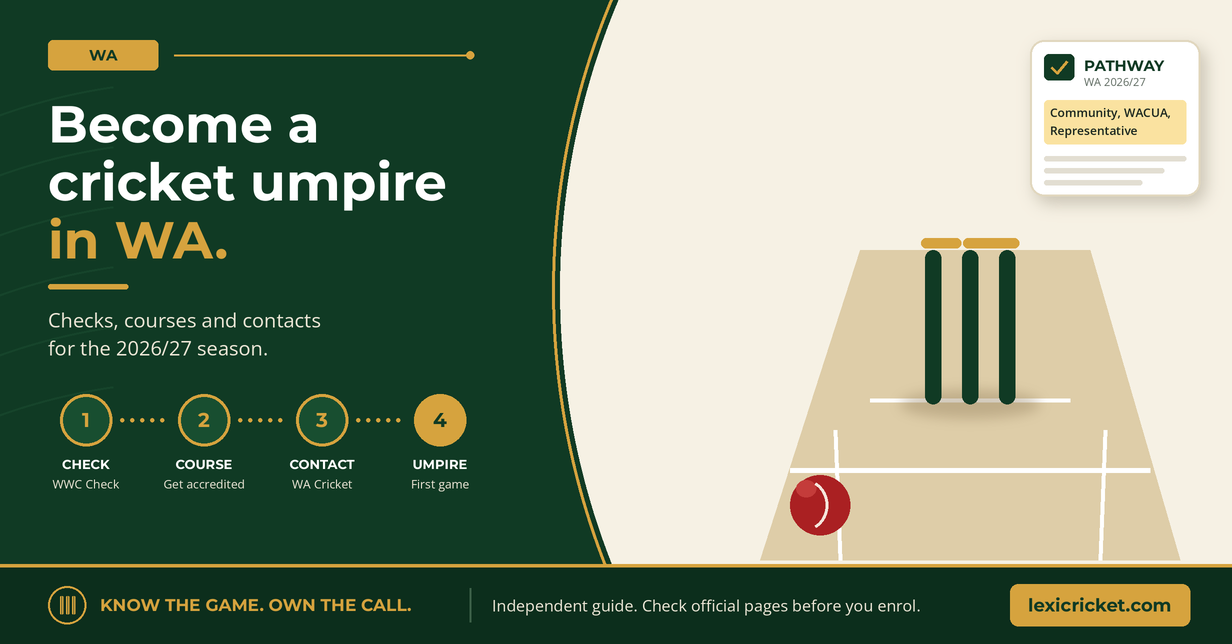
WA Cricket says anyone with a passion for cricket can become an umpire, and that it provides training and development to support you whatever competition you umpire in. If you have been thinking about standing in the middle rather than watching from the fence, here is how to start in Western Australia.
This guide covers the Working with Children Check, the course, who to contact in Perth and the regions, what to learn before your first match, and where the pathway leads.
LexiCricket is an independent reference tool and is not affiliated with WA Cricket, Cricket Australia, WACUA or any competition. Costs, dates and requirements change, so confirm them on the official pages listed at the end of this post before you commit. Details were last checked on 25 September 2026.
Who can umpire cricket in Western Australia?
WA Cricket puts it simply: anyone with a passion for cricket can become an umpire. You do not need a playing record, though knowing the game helps. What you need is a working knowledge of the Laws, clear communication and a willingness to be trained.
Age requirements depend on where you umpire. Cricket Australia encourages umpires under 15 to complete its Umpiring Junior Cricket digital learning before moving on to formal accreditation, and advises checking local age requirements with your state or local umpiring contacts.
Step 1: Get a Working with Children Check
Western Australia's check is run by the WWC Screening Unit at the Department of Communities, and it works differently from the eastern states in two ways that matter.
Everyone pays something. The current fees are $87 for paid employees and self-employed people, and $11 for volunteers and unpaid workers. If you do child-related work both as a volunteer and for payment, you must apply as a paid employee.
You apply on paper, in person. Application forms are hardcopy and available from authorised Australia Post outlets, where you lodge them. Your organisation also has to complete part of the form to verify your child-related work, so speak to your association or club before you go.
One useful quirk: the application receipt from Australia Post is proof of a pending application and, in most cases, lets you start or continue child-related work while it is assessed. That means you may not have to wait for the card itself, though people with a negative notice or certain pending charges cannot rely on this.
A WWC Card lasts three years, and it is an offence to keep doing child-related work with an expired card and no pending application.
Do umpires need one? WA Government guidance for the sport and recreation sector treats work for a club or association with significant membership or involvement of children as child-related work, so plan on needing a check unless an exemption applies. Common exemptions include volunteers under 18 and parents volunteering in many activities where their own child is involved. If your situation is not clear cut, ask your association and the WWC Screening Unit before your first match.
Step 2: Complete the Community Officiating course
Cricket Australia's entry-level accreditation runs on the PlayCricket Learn platform and needs a CricketPlus account. To start, go to PlayCricket Learn for umpires and select Start Course. Cricket Australia umpire accreditation is valid for four years.
Step 3: Get into WA Cricket's umpire training
WA Cricket runs a structured pre-season program at the WACA Ground, and it describes the WA Umpiring Ecosystem as covering all levels from community through to high performance and representative cricket.
In 2026 that program ran as:
- A new umpire introduction and welcome evening in mid-July, followed by weekly Wednesday evening sessions through July and August
- An online Laws of Cricket exam at the WACA Ground in August
- A full-day annual Umpire Development Seminar at the end of August, free for WA Premier Cricket umpires and $70 for everyone else
Those dates have passed for this season, so if you are starting now, use the register-your-interest form on the WA Cricket umpiring page and ask what is available mid-season. The same page lists a contact for community umpiring and umpiring in regional Western Australia, which is the right first call if you are outside the Premier Cricket system or based in the regions. Put next winter's pre-season program in your diary either way.
Some associations also run their own umpiring groups. The South Metropolitan Cricket Association, for example, says it has an Umpires Advisor who works closely with WA Cricket's umpiring manager, and around 40 umpires to help newcomers develop.
Step 4: Know what WA Premier Cricket offers
If you are aiming at WA Premier Cricket, WA Cricket lists what comes with it: ongoing training, development and support, what it calls attractive match payments, membership of the Western Australian Cricket Umpires' Association, and discounted WACA membership.
WACUA has been going since 1908 and is home to umpires officiating primarily in WA Premier Cricket. Its membership benefits include training, a buddy system for new members, an umpire support person for player reporting and tribunal matters, and a body that negotiates match payments with WA Cricket. Its site listed the annual fee as $65 for the 2025/26 season, so check the current figure before joining.
When you make contact with WA Cricket, WACUA or your local association, ask:
- How are appointments made, and how do you submit your availability?
- What uniform and equipment are expected?
- What are the match payments, and when are they paid?
- Which playing conditions apply to each grade?
- Who will mentor you through your first matches?
Step 5: Learn the Laws and your competition's playing conditions
Every match runs on two sets of rules: the MCC Laws of Cricket, and the playing conditions of your competition, which can change the Laws for things like overs, fielding restrictions and hours of play. Where a competition's playing conditions change a Law, the playing conditions apply in that competition. If that is new to you, read which cricket laws should govern my match.
A new edition of the MCC Laws takes effect on 1 October 2026, so study the current edition and check which edition your competition has adopted. The main changes are covered in the 2026 Laws of Cricket changes. WA Cricket publishes the WA Premier Cricket rules and playing conditions on its website, and links to the MCC Laws and the MCC's Laws e-learning from its umpiring page.
Match day: what to bring
Your association sets the uniform, so confirm that first. Otherwise, pack:
- A ball counter and a spare
- A pen and notebook or card for times, overs, penalty runs and incidents
- A watch or phone for hours of play and intervals
- Spare bails
- Your competition's playing conditions, printed or on your phone
- A hat, sunscreen and more water than you think you need for a Perth summer
Your first season: habits that help
- Arrive early enough to walk the ground, meet the scorers and settle before the toss.
- Confirm the details with both captains before play: start time, overs, intervals and competition-specific rules.
- If you have a colleague, agree who watches what and how you will signal to each other.
- Reconcile your over count with the scorers at every interval.
- Write down anything that left you unsure and look it up that night.
- Use the support around you. WA Cricket lists ongoing training, development and support among the benefits of umpiring, and WACUA runs a buddy system for new members.
Where the pathway can lead
WA Cricket describes its umpiring ecosystem as covering all levels from community through to high performance and representative cricket, and it has a State Umpiring Panel. It also runs an Umpire Observers Program, which is a way to stay involved and keep learning if standing every weekend does not suit you.
Where LexiCricket fits
Most questions in the middle come down to how your competition's playing conditions change the Laws. LexiCricket answers rules questions from the playing conditions of the competition you select and shows the clause behind each answer, so you can check it against the source. If your competition is covered, ask a question in the chat. It supports your training and judgement and does not replace either.
Umpiring in another state? Read the guides for Victoria, NSW and Queensland.
Frequently asked questions
Do I need a Working with Children Check to umpire in WA?
Plan on it. WA Government guidance treats work for clubs and associations with significant child involvement as child-related work. Exemptions exist, including for volunteers under 18 and for parents volunteering in many activities their own child is involved in, so confirm your situation with your association and the WWC Screening Unit.
How much does a WWC Check cost in WA?
$87 for paid employees and self-employed people, and $11 for volunteers and unpaid workers, at the time of writing. Unlike some states, the volunteer application is not free. The card lasts three years.
Can I start umpiring before my card arrives?
In most cases, yes. The application receipt from Australia Post is proof of a pending application and generally allows you to start or continue child-related work, with exceptions for people who have a negative notice or certain pending charges.
Do cricket umpires get paid in WA?
WA Cricket lists match payments among the benefits of umpiring in WA Premier Cricket, and WACUA negotiates those payments with WA Cricket. Ask your association about rates in community competitions.
When does umpire training run in Western Australia?
WA Cricket's pre-season program runs on Wednesday evenings through July and August at the WACA Ground, with a Laws exam in August and a full-day development seminar at the end of August. Register your interest through the WA Cricket umpiring page for the next intake.
How long does umpire accreditation last?
Cricket Australia umpire accreditation is valid for four years. Your WWC Card is separate and lasts three years.
Sources
- WA Cricket: Umpiring
- WACUA: Home
- WACUA: Join Us
- Cricket Australia: PlayCricket Learn, Umpires
- Cricket Australia: Community Umpire
- Cricket Australia: Umpire Development
- WA Government: WWC Check application and renewal process
- WA Government: WWC Checks in the sport and recreation sector (PDF)
- WA Government: Working with Children Checks guide
- South Metropolitan Cricket Association: Become an Umpire
Last checked: 25 September 2026.